
What Is Meta Muse AI? How Personal AI Agents Could Change Business in 2026
Meta's Muse is designed to browse, plan and complete tasks across apps with user oversight. Explore what personal AI agents mean for customer journeys, websites, operations and commerce.
Published by Mahir Web
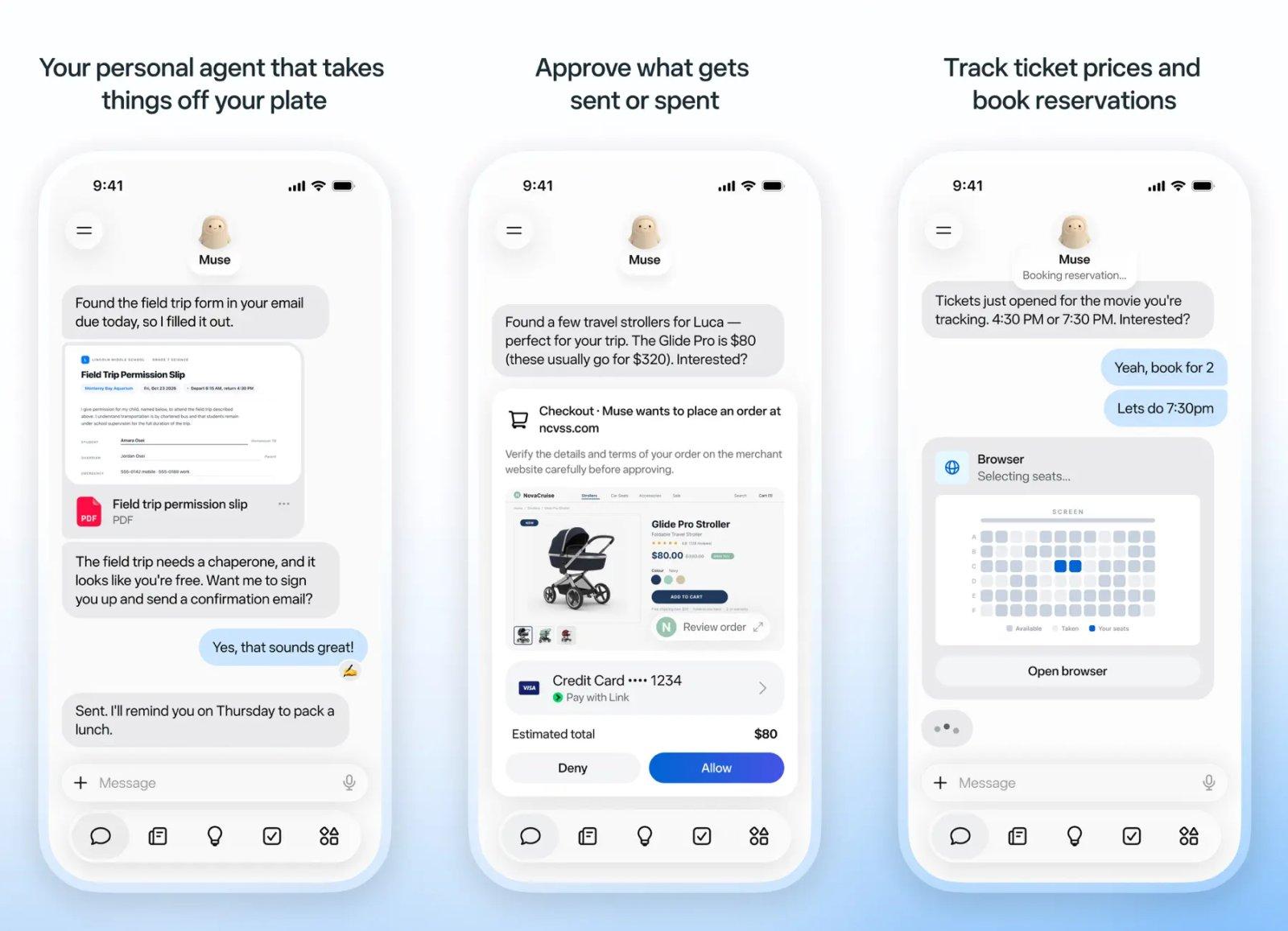
AI tools are moving beyond answering questions toward completing tasks. Meta's Muse is an example of that shift: a personal AI agent designed to work with apps, browse the web and handle multi-step requests with user oversight.
For business leaders, the important question is not whether every customer will install Muse. It is how websites, product information, service workflows and operational systems should evolve when customers increasingly delegate research and routine actions to AI agents.
What is Meta Muse AI?
Meta describes Muse as a personal AI agent that can research, plan, create documents, connect with supported apps and take actions on behalf of a user. Muse uses a dedicated secure virtual-machine environment with its own browser to navigate supported web experiences.
Meta describes approvals for important actions, including certain purchases and messages, alongside activity records and user control over app permissions. Read the official Meta Muse product overview for the latest supported features and availability.
How is a personal AI agent different from a chatbot?
A traditional chatbot primarily responds to messages. A more capable assistant may summarize information or produce content. An agent can combine planning with actions: navigating websites, interacting with apps, tracking progress and completing defined steps under permitted access.
Consider a customer planning a trip. Instead of asking for a list of destinations and personally opening every booking page, that customer might ask an agent to research suitable options, compare conditions and prepare a reservation. Depending on the agent's permissions and supported services, it may complete portions of that workflow while requesting approval for consequential actions.
What does Meta say Muse can do?
- Browse the web: use a secure computer and browser for supported multi-step tasks.
- Work with apps: connect to supported tools such as email, calendars and other daily services.
- Manage ongoing tasks: maintain task context, track goals and provide relevant follow-up suggestions.
- Help with commerce: support activities such as comparison, reservations and purchases with appropriate user permissions.
- Create outputs: generate documents, images and other artifacts.
Capabilities, integration availability and limits are product- and region-dependent. Businesses should not assume that Muse can access every website, app or private business system.
Why should businesses pay attention?
Agent-assisted discovery changes which details matter during a buying journey. Customers—or their agents—may need to understand pricing, delivery windows, services, refund conditions, qualifications, availability or integration requirements without relying on a long sales exchange.
This creates an opportunity for companies whose websites are accurate, structured and easy to navigate. It also raises challenges around authorization, anti-fraud measures, access controls and ensuring any machine-triggered action reflects the customer's real intent.
Five practical ways to prepare
- Clarify the offer: write specific service descriptions, eligibility, delivery scope, policies and frequently asked questions.
- Make important steps usable: keep forms, booking journeys and purchase paths reliable on different devices and accessible to users.
- Keep business facts synchronized: maintain consistent contact details, product information and availability across authorized systems.
- Design integrations carefully: prefer authenticated APIs, documented actions, consent and logging over unrestricted automation.
- Test real journeys: check how customers find information, compare options and complete tasks before deploying complex AI automation.
Will AI agents replace websites?
Not necessarily. Websites remain essential as authoritative destinations for business information, policies, transactions and customer support. Agentic interfaces may change how people arrive at those destinations or interact with them. A business should design for both human usability and machine-readable clarity.
Strong website engineering, search visibility foundations and secure AI automation are complementary—not competing—investments.
What about security and privacy?
Delegating tasks to an agent can involve sensitive permissions. Meta describes a secure runtime and approval-based controls, but businesses and individuals still need to review which systems are connected and what actions are authorized. For enterprises, use role-based permissions, explicit approval points, audit logs and appropriate controls around payments and customer data.
Where could agentic commerce go next?
Shopping, travel, software evaluation and customer support are plausible early use cases because they involve repeated comparison, form filling and status checking. But not every purchase or complex decision should be automated. Businesses should prioritize information quality and transaction integrity over speculative claims that AI agents will replace the whole customer journey.
Final takeaway
Muse is a useful signal: AI is becoming a tool that can act, not only answer. The most practical response is to improve the workflows customers already depend on. Mahir Web LLC builds connected business software, websites and guarded automation around those real needs. Talk to us about making your digital systems agent-ready.
Common questions
Frequently asked questions
Direct answers to the questions companies most often ask about this topic.
What is Meta Muse?
Muse is Meta's personal AI agent. Meta says it can use a secure browser environment, connect with apps, perform multi-step tasks and act with user permissions and oversight.
How is Muse different from an ordinary chatbot?
A chatbot mainly answers queries, while a personal AI agent can navigate systems, perform authorized actions, monitor tasks and complete workflows across multiple steps.
Can Muse make purchases or bookings?
Meta lists booking, shopping and other browser-based actions among Muse's capabilities, with permission and approval mechanisms for sensitive actions.
What should a business do to prepare for AI agents?
Make product and service information clear and current, reduce friction in booking and checkout, maintain reliable structured content, and secure customer-facing integrations.
Planning something complex?
Discuss the project with Mahir Web.
Share the business problem, current systems, scope, timeline, and what success needs to look like. We’ll review the requirements and determine the right technical approach.
Start a projectTopics
Related insights

AI Can’t Build Everything Overnight: What GTA VI Teaches Us About Software Development
AI can accelerate coding, but it cannot replace software strategy, architecture, testing, and execution. Here is what the long wait for GTA VI teaches businesses.

AI Automation ROI: How to Decide What Your Business Should Automate First
A decision framework for prioritizing AI and workflow automation based on staff time, repetition, error cost, speed, revenue impact, exception handling, and implementation risk.